Fair price. Sustainable practice.
About The Sustainable Artist
The Sustainable Artist was built because financial vulnerability quietly ends creative careers. All the work that never shows up on an invoice, the years of study, the unpaid practice, the emotional weight of making, is still real work. It still deserves to be counted.
Why this tool exists
This is advocacy, not charity. The idea that artists should work for exposure, together with the deep habit of undervaluing our own labour, has measurable economic consequences. The 2023 Structurally F–cked report by Industria and a-n, drawing on the Artist Leaks survey of visual artists working with UK publicly funded institutions, found a median hourly rate of £2.60, far below the UK minimum wage, while the same institutions paid their directors professional salaries. This tool gives artists a documented, calculated minimum they can stand behind.
The evidence for unfairness
This is not anecdotal. European institutions have written it down themselves, with their own numbers: the working conditions of artists and cultural professionals are structurally unfair, and something has to change.
“Cultural life flourishes when societies create the conditions that allow individuals and artists to experiment and push boundaries. This requires fair working conditions for artists and cultural professionals.”
The Compass commits the EU to propose an EU Artists Charter (Flagship action 7, due Q2 2027) in consultation with social partners and stakeholders. That charter is being written precisely because current conditions fall short. Fair pay and quality jobs in the cultural sector are treated here as an unresolved policy problem, not a solved one.
The numbers behind the Compass
In 2019, 32% of workers in the cultural and creative sectors in the EU-27 were self-employed, compared to just 14% in the total workforce. That is more than double the rate. Self-employment in this sector, the EENCA study for the European Commission (2020) noted, is linked to “lack of regular income, relatively low average income levels, less access to social security compared to employees and unfavourable tax regulations.”
The 2024 Creative Pulse survey, commissioned by Culture Action Europe and Panteia and disseminated by the European Commission through the OMC expert group, gathered responses from 1,204 artists and cultural professionals across 26 EU Member States, plus 293 cultural organisations. It found:
- “The overwhelming majority of artists feel that they are not remunerated fairly for their work.”
- Over two-thirds of artists surveyed lack access to sufficient social protection.
- Over two-thirds work more than one job to survive, and a third of those second jobs are outside the cultural sector.
- Almost half report poor working conditions overall. Visual artists and multidisciplinary artists are the most likely to report them.
- Women are more likely than men to report insufficient social protection and lack of fair remuneration. It is a gendered pay gap sitting on top of a sectoral one.
- 96% of surveyed cultural organisations, institutions and policy makers support a European status for artists that would guarantee “a right to fair remuneration”. Almost 90% call for EU legislation on working conditions.
These findings sit alongside the 2023 OMC (Open Method of Coordination) report The status and working conditions of artists and cultural and creative professionals, commissioned by the EU Council of Ministers under the Work Plan for Culture. It calls on Member States to guarantee fair remuneration, minimum fees and access to social security for cultural workers, because in its own words unpaid or underpaid labour is the norm rather than the exception.
This continues the unfinished work of the UNESCO 1980 Recommendation on the Status of the Artist, which asked Member States 45 years ago to ensure fair remuneration for creative work. That the EU is still writing a Charter in 2027 to address the same problem is, in effect, an admission that the Recommendation is still not implemented.
The pattern is clear. Two-thirds of artists without adequate social protection. Two-thirds working a second job. A self-employment rate more than double the general workforce. An “overwhelming majority” who do not feel fairly paid. Underpricing is not a personal failing. It is a documented, structural condition of the sector, and this tool exists to give artists one concrete way to push back.
Sources
- Culture Compass for Europe, Key direction 2: Artists and people (European Commission, 13 November 2025)
- Culture Compass for Europe, Flagship actions, incl. EU Artists Charter due Q2 2027 (European Commission)
- The status and working conditions of artists and cultural and creative professionals, OMC report (EU, 2023)
- The status and working conditions of artists and cultural and creative professionals, EENCA study for the European Commission (2020)
- Creative Pulse: A survey on the status and working conditions of artists and CCS professionals in Europe, Panteia and Culture Action Europe (May 2024)
- Structurally F–cked: an inquiry into artists' pay and conditions in the public sector, Industria and a-n The Artists Information Company (2023)
- UNESCO Recommendation concerning the Status of the Artist (1980)
Parenting and caregiving
Fair pay is not gender-neutral. The artists who are already underpaid tend to be the same people who carry the unpaid work of raising children and caring for family members, and most of them are women. When a pricing model ignores that, it quietly pushes those artists out of the profession.
The UK's Balancing Act survey (Parents and Carers in Performing Arts with Birkbeck, University of London, more than 2,500 performing arts workers) is one of the most careful data sets on this. It found:
- Parents and carers earn a median of £20,000 per year. That is a 13% pay gap compared with £23,000 for those without caring responsibilities.
- 76% of parents and carers have turned down work because of childcare. For women it rises to 80%.
- 45% have changed their work location and 37% have changed their role because of caring responsibilities.
- Parents and carers are far less likely to hold full-time work in the sector (29% versus 45%).
- 43% of those who left the performing arts entirely said being a parent was the biggest reason.
In UK visual arts, the DACS Artist Earnings Survey 2024 (CREATe at the University of Glasgow, 1,241 respondents) found that the median annual income for self-employed visual artists is just £12,500. That is 47% below the full-time minimum wage of £23,795, and a 47% real-terms decline since 2010. Among visual artists whose main occupation is art, 65% earn below minimum wage. Add primary caregiving on top of that baseline and a sustainable career becomes arithmetically impossible without a second earner or family money.
The 2024 Creative Pulse survey confirmed the pattern is Europe-wide, not just British. In its words, “women are more likely than men to report poor working conditions, insufficient access to social protection and lack of fair remuneration.” The 2020 EENCA study for the European Commission names the same groups, women, young people and disabled people, as most likely to face precarious conditions.
The 2025 peer-reviewed study The parenthood penalty in creative occupations (Feder, Florisson, O'Brien, Taylor and McAndrew, Work and Occupations) shows the penalty is measurable, worsened by the pandemic, and specific to creative work. Portfolio careers, unpredictable hours and unpaid preparation collide with caregiving in a way regular employment does not.
This is why the calculator counts your hours honestly and includes health, retirement and emergency buffers by default. A price that ignores caregiving is a price only artists without caregiving responsibilities can afford to charge. That is not fairness. That is a filter.
Who built it
Dr Tsendpurev Tsegmid — an artist, curator and researcher born in socialist Mongolia and shaped by the country's transition to democracy. Trained initially in painting and later in contemporary art photography, and holding a PhD in practice-based art, she has lived and worked in Mongolia, the UK, and now Germany. Over the past two decades, she has developed expertise in curating, project management, mentoring, and consulting. With roots in both Mongolia and Europe, she initiated New Wind: Art of Mongolia, Rewritten for the World to create fair, accessible pathways for Mongolian artists to be seen, supported, and taken seriously internationally.
13 August 2025 · Ulaanbaatar, Mongolia
Born in a Workshop
The Sustainable Artist began in a half-day workshop on 13 August 2025, held in the studio of artist Bulgantuya Dechindorj in Ulaanbaatar, Mongolia. What started as a conversation about pricing became a reckoning: not one of the five women artists present had ever calculated the true cost of their work. Years of study, thousands of hours of practice, materials, overhead, emotional labour — none of it had been counted. This tool was built to make sure it is counted.
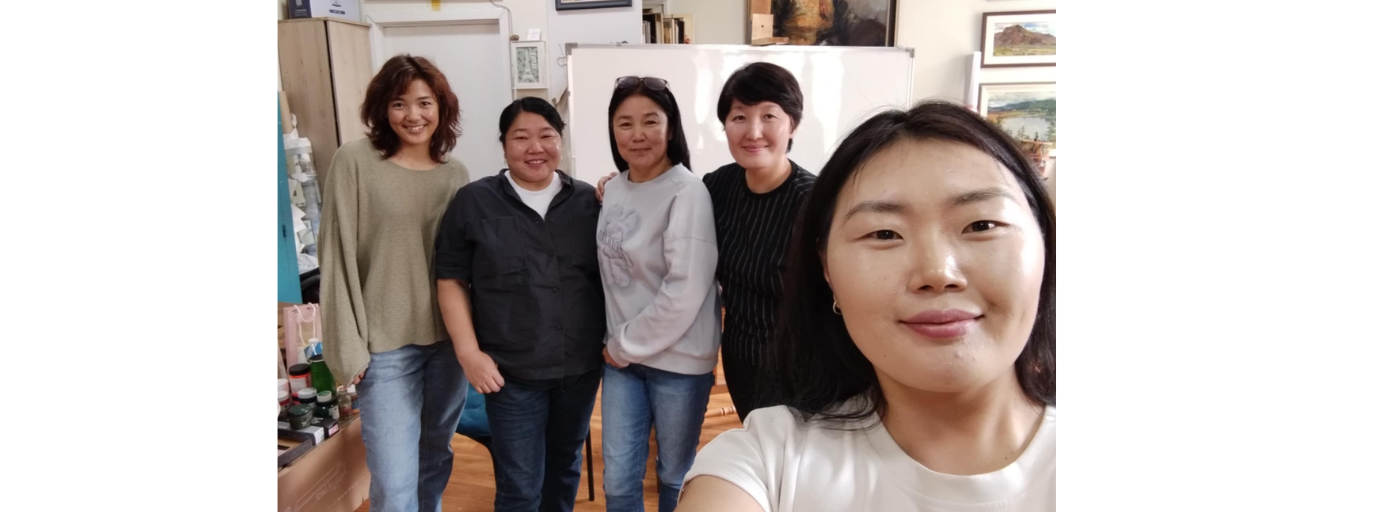
Co-founding artists
- Khandaa Batbaatar
- Soyolmaa Davaakhuu
- Bulgantuya Dechindorj
- Tsendpurev Tsegmid
- Sainbayan Iderchuluun
The five women artists whose insights shaped the original Mongolian version. Without that workshop this tool would not exist.
Our commitment to the artists who started this
This tool was built with artists, not just for them. The five women artists whose insights shaped the original Mongolian version are its co-founders in the fullest sense. If The Sustainable Artist generates income at any point, a share of that income will be distributed to them. This is not a gesture. It is the same principle the tool asks artists to apply to their own work: if your contribution has value, it should be compensated.
Contact & collaboration
Your feedback shapes this tool. If something felt off, unclear, or missing, or if you want to share how you are using it, I would genuinely love to hear from you. Artists, galleries, fintechs, cultural organisations, educators, and accelerator programmes are all welcome to get in touch.
On data protection: the calculator does not save, send, or store any of your inputs. Everything stays in your browser, so there is nothing to worry about.
Email me directly at dr.tsegmid.art@gmail.com
Embed the calculator on your site
Please help this reach more artists. If you run a gallery, studio, union, arts council, school, or any organisation that supports artists, embed the calculator on your website so your community can use it in one click. Copy the snippet below, or write to me and I will help you set it up.
<iframe
  src="https://sustainable-artist.com/calculator"
  title="The Sustainable Artist — Pricing Calculator"
  width="100%"
  height="1200"
  style="border:0;max-width:100%"
  loading="lazy"
></iframe>
Support this work
An honest ask. I am building The Sustainable Artist on my own time, for free, and paying out of pocket for the subscriptions that keep it online. If the tool has been useful to you, or if you believe in what it stands for, a contribution helps keep it alive and independent.
Thank you. Every contribution, at any amount, makes a difference.
Fair price. Sustainable practice. — The Sustainable Artist